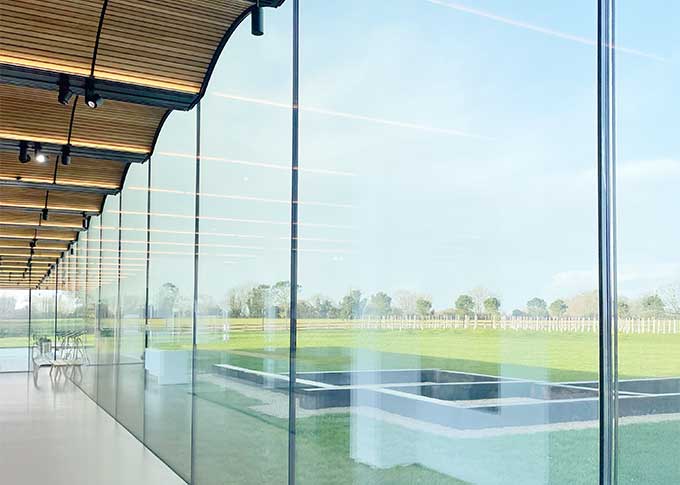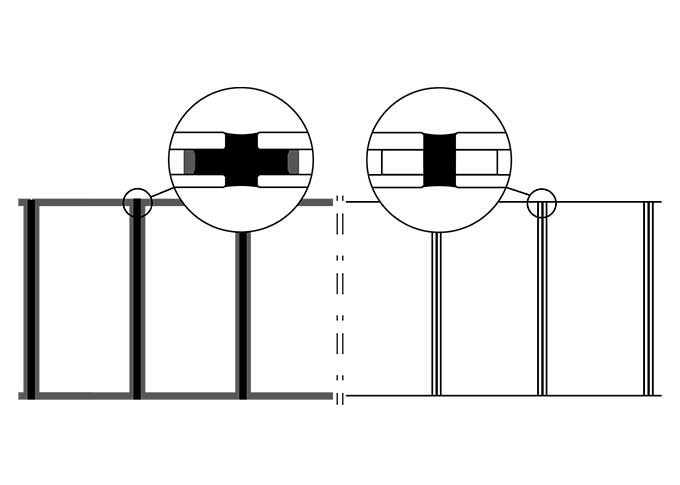

In large-format all-glass façades, one small detail often has a disproportionate visual impact: the dark edge seal.
For decades, architects have pursued façades that feel as continuous, quiet, and transparent as possible. Glass formats have grown dramatically, enabling larger surfaces to shape daylight, atmosphere, and the overall experience of architecture. Yet in conventional insulating glass, visible black or gray spacer lines still interrupt that vision, forming a pronounced visual grid across the façade.
What is technically necessary in standard insulating glass often becomes a defining aesthetic element. For projects that aim for a calm, nearly seamless glass surface, this has long meant a compromise between visual clarity and building performance.
That is now beginning to change.
With sedak isopure®, visible edges can be detailed with a transparent glass spacer made of low-iron glass rather than a conventional opaque spacer. The result is an insulating glass unit with a significantly reduced joint appearance — and a façade that reads as lighter, more refined, and more continuous.
This matters because architecture is shaped not only by geometry, but by detail. Lines, transitions, and connections influence how a building is perceived. When visible joints are minimized, the glass itself comes forward: as light, as reflection, as openness, and as atmosphere.
For architects and façade designers, this opens up new possibilities wherever transparency is central to the design concept — from cultural buildings and museums to retail architecture, glass roofs, and expansive all-glass façades.
What makes this development especially relevant is that it is not simply an aesthetic improvement. It also supports the performance requirements of contemporary building envelopes. With sedak isopure®, architects can pursue a more seamless façade expression while still meeting demanding technical criteria, including high thermal performance, compatibility with solar control and low-E coatings, and large-format applications up to 3.6 x 20 m.
In other words, the conversation no longer has to be framed as a choice between visual clarity and insulating performance.
This is particularly relevant in projects where the building envelope plays a key role in shaping spatial perception. In museum and cultural architecture, for example, glazing strongly influences the relationship between light, materiality, and the visitor experience. Where transparency and stillness are essential to the architectural expression, minimizing visible joint lines can make a decisive difference to the overall reading of the façade.
As façades become larger, lighter, and more transparent, details like the spacer become increasingly important. What once seemed like a minor technical necessity is now emerging as a true design variable.
And that changes the way we think about insulating glass.
Download the sedak isopure® datasheet to explore formats, performance values, and application possibilities for façades, glass roofs, and frameless glazing.