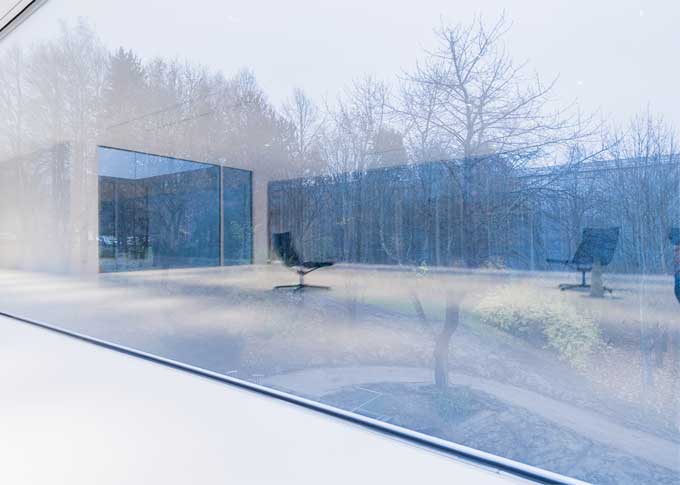

Security requirements are increasingly becoming an integral part of building design – from embassies and public buildings to transportation infrastructure and exclusive private residences.
This creates a particular challenge for architects and façade consultants: How can a high level of ballistic protection be achieved without unnecessarily compromising transparency, geometry and the architectural quality of the building envelope?
Modern bullet-resistant glazing therefore needs to do more than protect. It needs to integrate technically and visually into the architecture.
Bullet-resistant glass – at a glance
sedak develops bullet-resistant glass solutions for security-critical architecture. The systems are polycarbonate-free and combine certified ballistic protection with oversized and curved glass manufacturing. sedak isosecure® offers bullet-resistant insulating glass from BR2 NS to BR7 NS, while sedak secuprotect® provides laminated ballistic glazing from BR3 NS to BR7 NS as well as STANAG 4569 Level 3. Both product families are available for flat and curved geometries.
When security becomes visible
Conventional security glazing can become visually dominant due to substantial glass thicknesses, complex laminates and additional materials. This can conflict with the architectural concept of transparent façades. Large glass surfaces are intended to appear light, calm and visually consistent – even when they need to meet demanding security requirements. The goal should therefore not be to add security to the architecture as an afterthought. Security should be part of the building envelope from the very beginning.
Glass instead of polycarbonate
sedak relies on polycarbonate-free glass constructions for its bullet-resistant solutions. This provides several advantages for demanding architectural applications.
► Durable glass surfaces: Without polycarbonate, the characteristic properties of a glass surface are maintained. This increases scratch resistance and avoids material-related yellowing associated with polycarbonate over time.
► Functional coatings: Solar-control, thermal-insulation and anti-reflective coatings can be integrated depending on glass dimensions, construction and bending requirements.
► Oversized transparency: Depending on technical feasibility, certified glass constructions can be manufactured in sedak dimensions of up to 3.6 × 20 m.
► Flat and curved: Bullet-resistant glazing does not have to be limited to flat rectangular panels. Certified curved configurations extend the possibilities to architecturally demanding geometries.
Two systems for different requirements
sedak isosecure® – bullet-resistant insulating glass
sedak isosecure® combines ballistic protection with the functionality of an insulating glass unit. The system covers resistance classes from BR2 NS to BR7 NS according to DIN EN 1063 and is particularly suited to façades and other exterior building-envelope applications. Flat and curved configurations are available.
sedak secuprotect® – bullet-resistant laminated glass
sedak secuprotect® is a high-performance laminated ballistic glazing system. Solutions range from BR3 NS to BR7 NS and additionally include STANAG 4569 Level 3. Its symmetrical construction provides protection from both attack directions, while curved geometries are also possible.
Security as part of the building envelope
Bullet-resistant glazing is not an isolated security component. In façade applications, it must meet requirements for transparency, thermal performance, solar control, geometry, glass dimensions and architectural quality at the same time. This changes the planning process. Instead of adding security glass at the end of the design phase, the required resistance class and glass construction should be considered together with the other façade requirements as early as possible. This allows the security function to become an integral part of the architecture rather than a visible addition to it.
What architects should define early in the project
Several factors determine the appropriate bullet-resistant glass construction:
► Protection level – Which ballistic threat needs to be addressed?
► Application – Is laminated ballistic glass or bullet-resistant insulating glass required?
► Dimensions – What glass sizes are defined by the architectural concept?
► Geometry – Does the project require flat or curved glazing?
► Coatings – Are solar-control, thermal-insulation or anti-reflective coatings required?
► Installation – How will the glazing interact with the frame, façade system and adjacent construction?
The final glass configuration should therefore always be defined as part of the project-specific engineering process.
Protection without compromising architecture
Security requirements are increasing. At the same time, architects are demanding greater transparency, larger glass surfaces and more individual geometries.
Bullet-resistant glazing does not have to force a choice between these requirements.
When security is considered early in the design process, it can provide exceptional technical performance while remaining almost invisible architecturally.